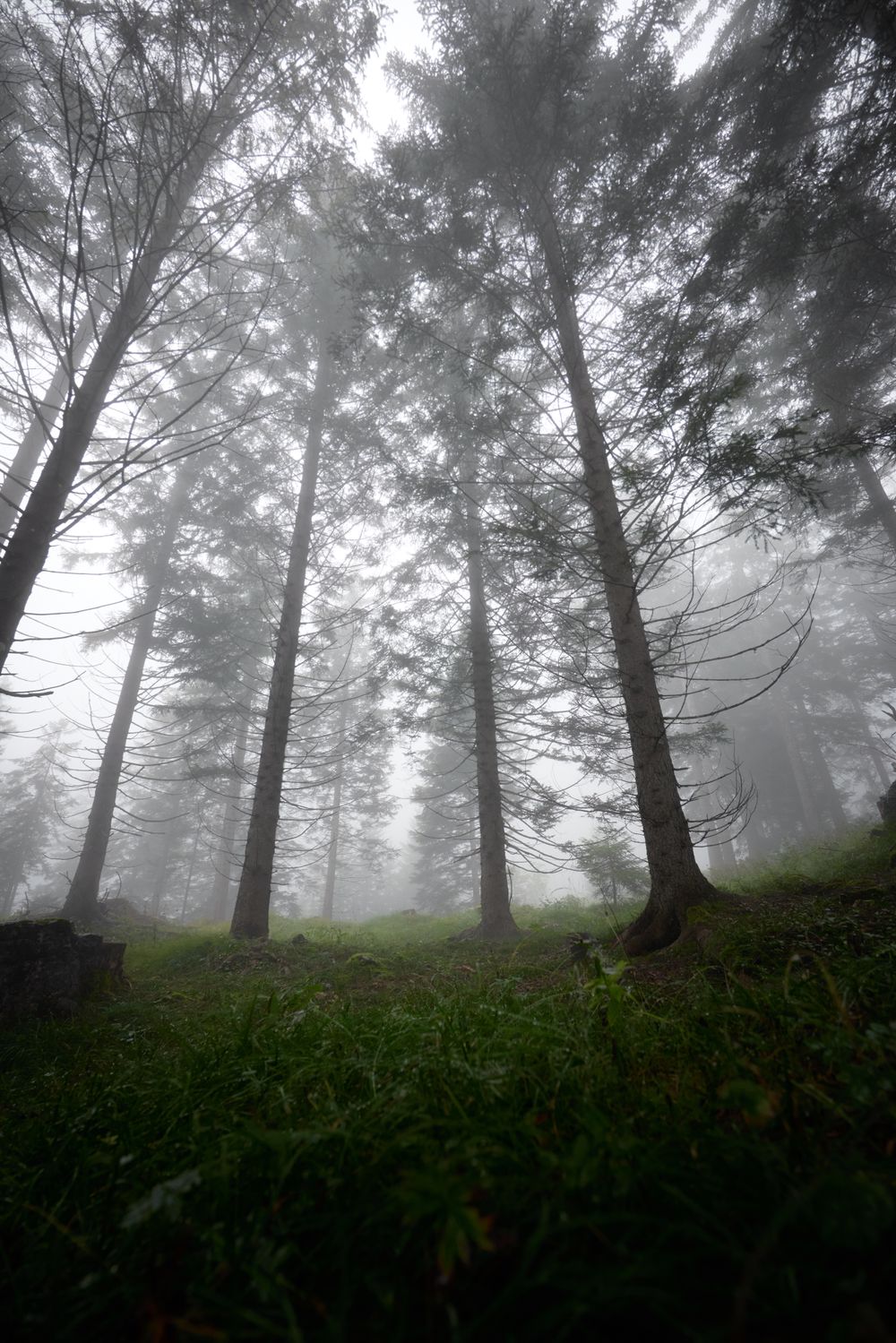
Some landscape photographs ask us to look out toward a horizon. This one asks us to look up. Tall trunks establish a rhythm, and the mist turns the upper part of the frame into a softer, lighter space.
The vertical view
A vertical composition changes the pace of a forest image. Instead of scanning across a wide canopy, the eye follows individual trees from their darker lower forms toward the light above. The repeated shapes are similar enough to feel orderly and different enough to remain interesting.
The lightest part of the image is not a separate object. It is an opening, a patch of atmosphere that gives the darker branches their outline. That balance between something visible and something almost absent is what holds the frame together.
A change in direction can be enough to make a familiar view feel new.
One detail at a time
Begin with the nearest trunk. Notice where its edge is sharp and where it blends into the background. Then find a second tree farther away. The relationship between those two forms can tell you more about the picture's depth than a long glance at the entire scene.
This is a small exercise in attention, and it does not require a remarkable location. A familiar tree seen from a different angle can offer the same opportunity: to pause, choose a detail and let the rest of the scene gather around it.
An editorial reflection on landscape photography. Images are credited to their creators; these essays are not firsthand travel reports.