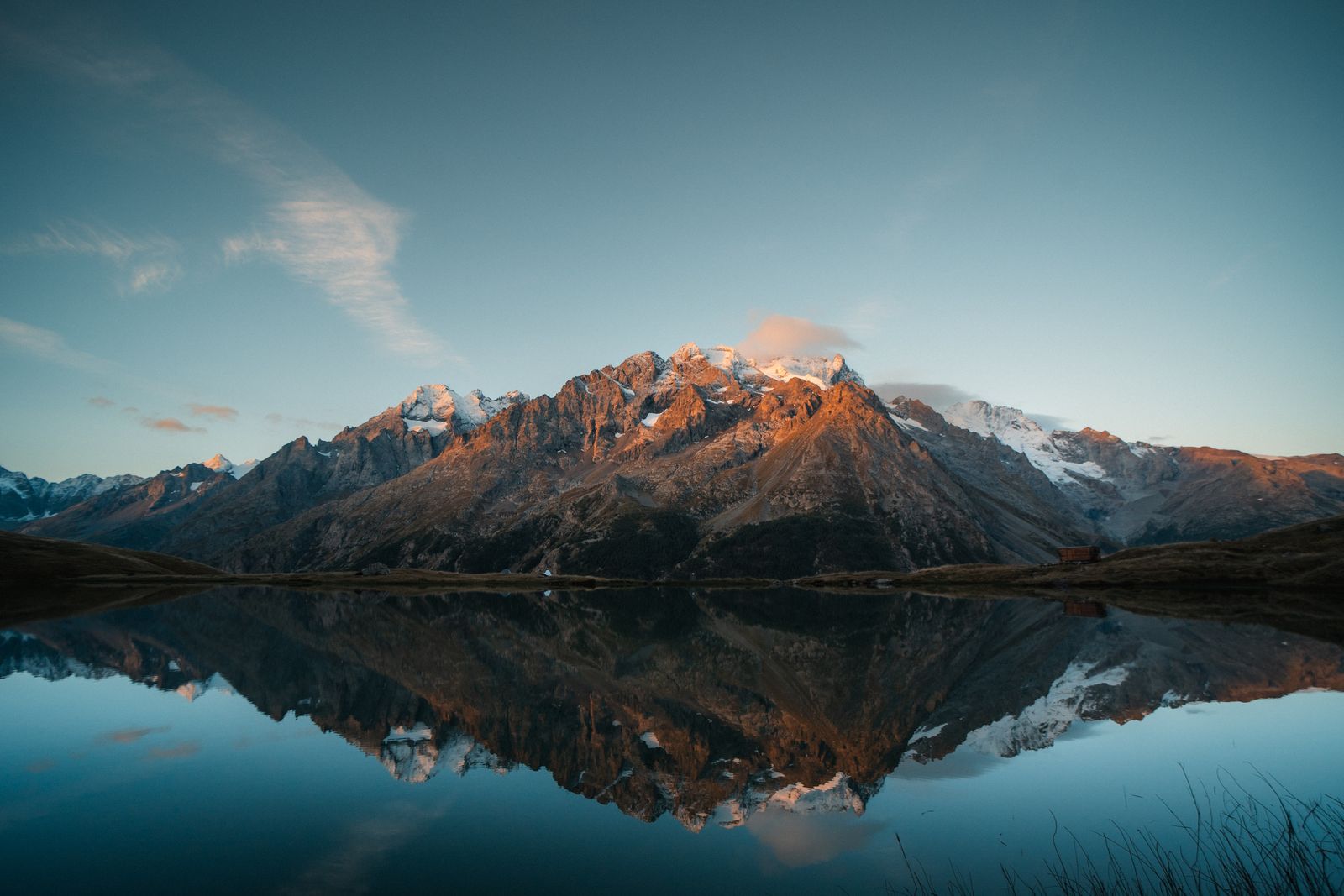
At first the mountain is the subject. Then the reflection begins to compete for attention. A dark ridge appears twice, once against the sky and once inside the lake. The photograph offers a familiar view with an unfamiliar amount of balance.
Above and below
The upper half of this scene feels solid: stone, snow and the distinct profile of a ridge. Below it, those same shapes become a softer version of themselves. The reflection is close enough to suggest symmetry, but the slight differences keep the image from feeling mechanical.
Look at where the two halves meet. The far bank acts as a quiet hinge between mountain and water. It gives the eye a place to settle before moving upward into the peaks or downward into their darker echo.
A reflection is another way of looking at what is already there.
The value of a small disturbance
A perfect mirror can be striking, but a few small interruptions make a scene more inviting. The uneven shore and the textures near the water remind us that this is a place, rather than a pattern. There is room for detail inside the larger arrangement.
For a different reading, cover the mountain with your hand and look only at the reflection. The picture becomes more abstract: bands of blue, light against dark, an inverted shape that takes a moment to recognise. Uncover the peak and the landscape comes together again.
That shift is the pleasure of spending time with a single image. There is no need to move on to a grander view. The same frame can hold several different ways of looking.
An editorial reflection on landscape photography. Images are credited to their creators; these essays are not firsthand travel reports.