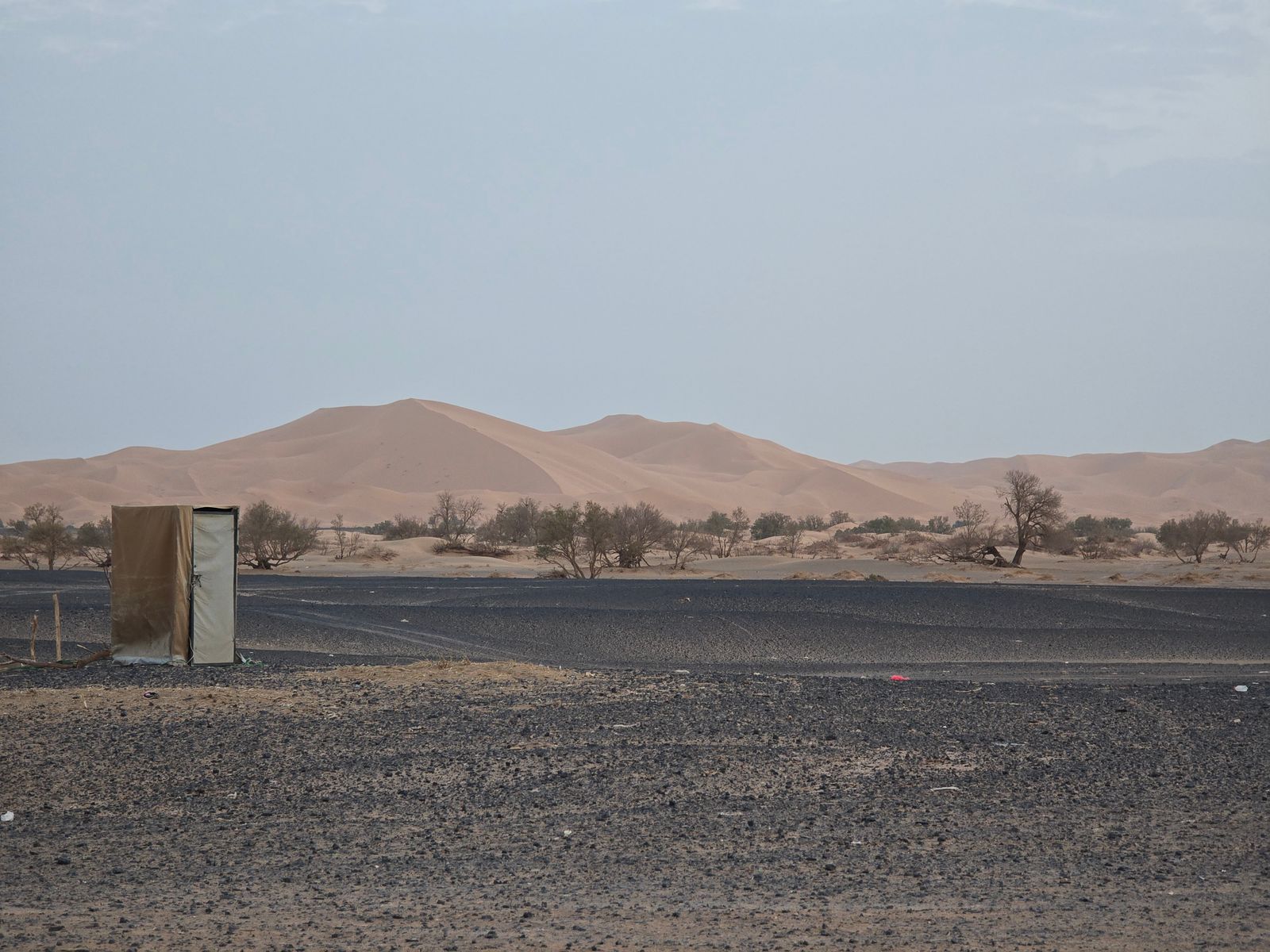
The desert in this photograph is not a blaze of orange. Its colours are restrained: muted sand, grey-blue sky, small dark marks of vegetation. Photographed near Zagora in Morocco, it is a landscape that rewards a slower look.
Reading a spare composition
With fewer strong colours to separate foreground and background, shape does more of the work. The low ridges overlap. A patch of shade marks a change in slope. The horizon gives the scene a limit without making it feel enclosed.
Try looking at the picture as an arrangement of light and dark rather than as a place. The scattered plants become punctuation. The dunes become long, unbroken phrases. Small variations begin to matter because there is so little visual noise around them.
A spare landscape gives each small detail a little more room.
Enough to hold the eye
An open landscape does not need an obvious centrepiece. Here, interest is distributed across the frame. No single ridge asks for all the attention, and the pale sky has a useful role: it leaves room above the repeating shapes of the land.
This kind of image is a reminder that quietness and emptiness are different things. The scene contains texture, rhythm and subtle contrast. It simply offers them without a dramatic foreground or a saturated sunset.
Stay with one small section of the image, then step back to see the whole. The change in scale is part of the experience: an individual mark becomes a minor detail again, and the open space takes over.
An editorial reflection on landscape photography. Images are credited to their creators; these essays are not firsthand travel reports.